

 Meghan Kelly
The grid is often understood as a visual system, a visual organizing device synonymous with modernist abstraction and the legacy of Minimalism. Yet this framing obscures the grid’s longer, more materially grounded history as a mode of making embedded in global craft and art traditions. At this year’s College Art Association 114th conference, Grids Across Borders: Art, Craft, and the Global Context, a workshop led by Textile Design Associate Professor Meghan Kelly and Temple University PhD candidate Jessica Braum, challenged this narrow understanding by situating the grid as both a conceptual framework and an embodied practice. Through a combination of critical presentation and hands-on weaving, the workshop asked participants to reconsider the grid not as an abstract formalism, but as a material structure through which knowledge, labor, and cultural meaning are produced.
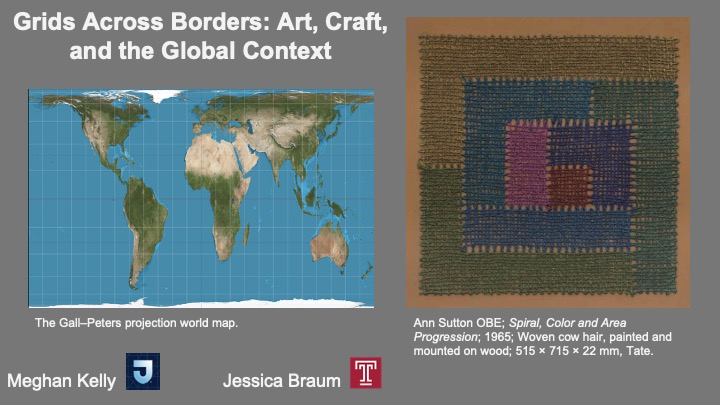
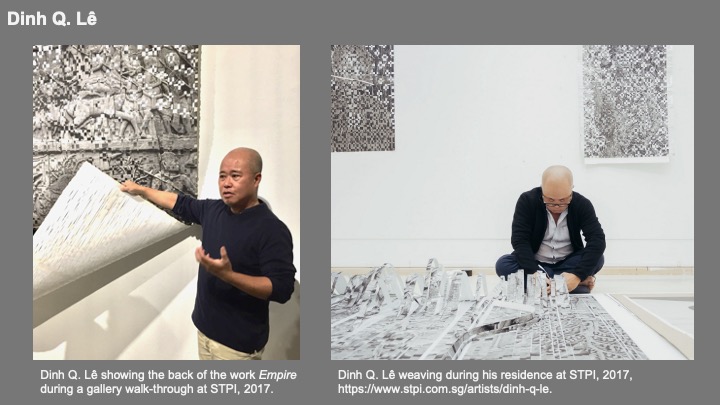


Jessica Braum posits that, “While the grid is commonly associated with Minimalism, a movement that emerged in the late 1950s and is frequently linked to male artists in New York, it has broader historical and cultural significance. Grids have been employed for both aesthetic and functional purposes across diverse global contexts, predating and extending beyond the rise of Minimalism”. Underpinning this statement were a curated selection of eight contemporary artists who use the grid in their work to carry meaning, feeling, and critical assessment forward to the viewer: Agnes Martin, Kim Lim, Rasheed Araeen, Yolanda Laudico, Dora Maurer, Anni Albers, Sopheap Pich, and Dinh Q. Le. Taken together, these artists represent a global and material reach that extends before and after the recognized roster of white, male, mostly American artists that traditionally define the Minimalism canon.

Textile designers and artists readily recognize the grid not only as a conceptual tool, but as the foundation of woven cloth itself. Woven fabric is a grid; it does not merely employ the grid as a formal language. Knitted fabric, by contrast, is not structurally gridded in its interlacing loop construction. Yet, its construction still unfolds through a gridded logic, with each stitch positioned in relation to its neighbors and stacked course upon course. As an ancient, global, and materially rich practice, textiles offer clear evidence that the grid predates, exists alongside, and will persist beyond the relatively narrow historical moment of Minimalism. Jessica brilliantly breaks down this idea by arguing that in craft traditions, structure and execution are inseparable. In the context of this workshop, she frames the grid simultaneously as a visual template, a set of instructions, and a site of material negotiation. This reframing expands the grid beyond a system of visual organization, inviting it to be understood and experienced as a physical, embodied practice.


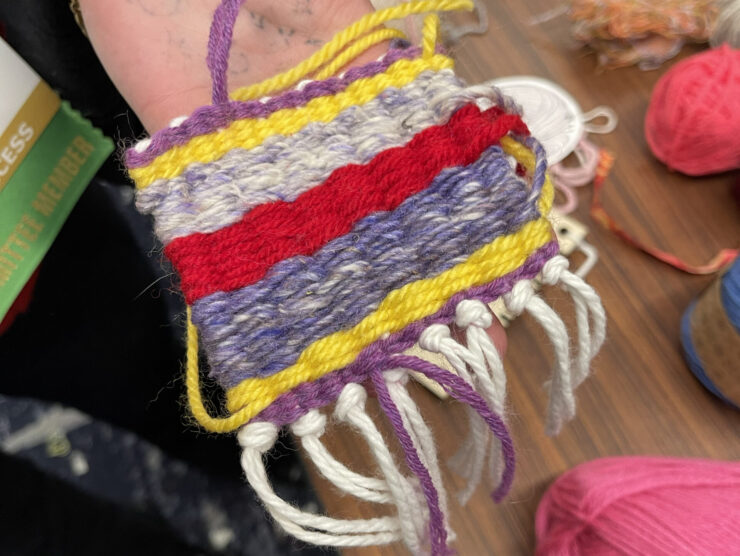
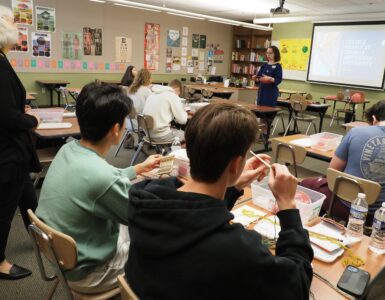
The second portion of the workshop shifted from theory to practice as participants were invited to weave on small, frame looms. Meghan Kelly guided the group through tabby, or plain weave, a structure that is deceptively simple in form and exacting in practice. While a few attendees were artists or designers familiar with weaving, most were art historians who found themselves briefly inhabiting the position of the student, encountering the productive humility of learning by hand. Using three instructional supports: a QR‑linked video loop, a step‑by‑step handout, and a full‑color slide deck with verbal instruction, participants gathered yarn, fabric strips, felt, and ribbons, weaving together textures and colors as they talked and connected with one another. As attendees started weaving, they actively engaged with the grid, embodying the theory of the grid as a material negotiation as they pushed and pulled textile materials into place. Many participants did not complete their small croquis within the workshop’s timeframe, a familiar outcome of learning a new skill. They were encouraged to take their looms and materials with them, extending their engagement with the grid beyond the room and into continued practice.
The introduction of theoretical frameworks related to the grid combined with hands-on making, through weaving, provided an extremely engaging conference session format that combined art historical research and studio art experimentation in an original way. I also really appreciated how meticulously the looms and weaving materials were prepared in advance, in addition to the instructional video that was accessible for participants by scanning a QR code. – Steve Rossi, Associate Professor of Sculpture, St. Joseph’s University
As a final extension of this embodied engagement, participants were invited to carry their reflections beyond the workshop itself. Meghan and Jessica distributed postcards and stamps, encouraging attendees to jot down a few lines about their experience and mail back their thoughts. Designed with bold colors and illustrations of previously woven samples rendered in thick black linework, the postcards echoed the workshop’s central premise: that the grid is not only a visual device but a site of ongoing aesthetic, structural, and material dialogue. In offering this final gesture, the facilitators invited participants to continue negotiating the grid through memory, writing, and continued making, long after the looms had been set aside.




Add comment